

Ghosts and Hauntings at Hogwarts – Peeves the Poltergeist
In the Harry Potter universe, Hogwarts is home to a colourful and diverse array of inhabitants (including some who aren't technically alive). Alongside witches and wizards, the castle is filled with ghosts, spirits and extraordinary supernatural beings. Among the most memorable – and certainly one of the most mischievous – is Peeves the Poltergeist.
The Harry Potter books portray Peeves' ghostly yet decidedly noisy existence in a wonderfully entertaining, often humorous and occasionally rather eerie way. Unfortunately, Peeves was left out of the film adaptations entirely .
This article takes an in-depth look at ghosts and the nature of their existence in the Wizarding World, while exploring Peeves' character, his role in the story and his unusual status as a poltergeist . We'll also examine why these scenes are so important to the atmosphere of the books, and how Peeves' absence changes the feeling of Hogwarts in the films.
Ghosts and Spirits in the Wizarding World
Why and How Do Spirits Remain in the World?
According to the Harry Potter canon (particularly Harry Potter and the Order of the Phoenix and Pottermore's material on ghosts), ghosts are the remnants of witches or wizards who, at the time of their death, could not or did not wish to move on to the afterlife. This is often connected to powerful emotions, fear or sorrow. However, ghosts are not living beings in the usual sense: they have no physical bodies, only their spectral forms. They cannot properly experience tastes, smells or the pleasures of life, and many remain attached to places where they lived or died.
Different Types of Supernatural Existence
In the Harry Potter books, we mainly encounter two distinct kinds of ghostly or spirit-like beings:
- Traditional ghost: The spectral remnant of a deceased witch or wizard, appearing as a translucent figure. Examples include Nearly Headless Nick , the Bloody Baron and the Grey Lady .
- Poltergeist: A non-human entity formed from energy and mischievous forces , rather than the spirit of a dead wizard. Peeves is the most prominent example in the Wizarding World. A poltergeist is a chaotic presence capable of affecting physical objects, seemingly fuelled by students' pranks, youthful energy and the magical atmosphere within the walls of Hogwarts.
The Ghosts of Hogwarts
The House Ghosts: Icons of the Four Hogwarts Houses
Each of the four Hogwarts Houses – Gryffindor, Slytherin, Ravenclaw and Hufflepuff – has its own official House ghost:
- Nearly Headless Nick (Sir Nicholas de Mimsy-Porpington) – Gryffindor
- The Bloody Baron – Slytherin
- The Grey Lady (Helena Ravenclaw) – Ravenclaw
- The Fat Friar – Hufflepuff
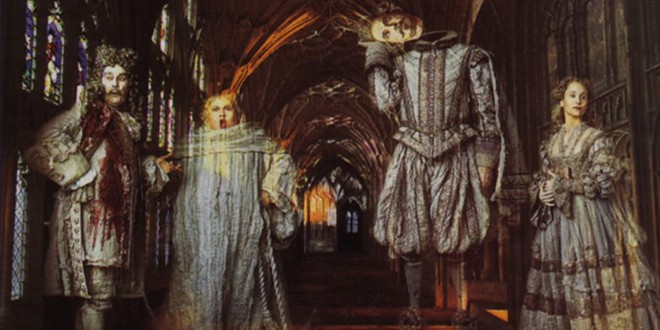
Each of these ghosts has a history, a personality and sometimes a tragedy of their own. The Bloody Baron's bloodstained clothing, for example, is connected to the death of Helena Ravenclaw, while Nearly Headless Nick's partially severed head prevents him from joining the Headless Hunt. These ghosts play their own parts throughout the school year: some develop relatively friendly relationships with students and offer help, while others – particularly the sinister Bloody Baron – inspire fear.
Other, Lesser-Known Ghosts and Ghost Stories
The books, and the additional material associated with Pottermore , contain occasional references to other spirits, sometimes unnamed, that inhabit corridors, side rooms or areas around the grounds. Some are said to linger because of unfinished business. Fan stories have also invented ghosts of their own, such as:
- The Broom-Cupboard Ghost (a fan-created name): Some unofficial stories describe a misty apparition living in a Hogwarts broom cupboard, sometimes frightening students at night with a low, murmuring voice.
- The Library Ghost: According to some fan rumours, the ghost of a former librarian haunts the Restricted Section. This has not been confirmed in official canon and belongs to the realm of fan fiction.
Peeves the Poltergeist: Background and Personality
What Is a Poltergeist in the Harry Potter Universe?
The word poltergeist comes from German and literally means "noisy ghost" ( poltern means to make a racket, while Geist means spirit or ghost). In the Harry Potter books, a poltergeist is a supernatural being that does not originate from a dead person's soul, but instead embodies unruly mischief and creative chaos. At Hogwarts, Peeves is a perfect example of this phenomenon:
- He is not the ghost of a former student or teacher, but appears to be a natural manifestation of the school's restless energy.
- He can interact with the physical world much more directly than ordinary ghosts. Peeves throws objects, slams things about, appears and vanishes unexpectedly, and is rarely concerned about the damage or alarm he causes.
Peeves' Connection to Hogwarts
The books suggest that Peeves has been at Hogwarts since the school's earliest days, or at least for a very long time. Even Albus Dumbledore seems to tolerate his presence rather than attempt to drive him away. Removing Peeves would be extremely difficult, and only a handful of figures – notably the formidable Bloody Baron , or exceptionally powerful and authoritative members of staff – seem capable of exerting much influence over him.
Peeves makes his presence felt almost immediately in Harry Potter and the Philosopher's Stone , causing a racket and getting on the students' nerves. He reappears throughout the series, constantly finding new ways to make himself a nuisance. Few things give him more pleasure than obstructing students, outwitting teachers or loudly revealing the location of someone who would much rather remain hidden.
Differences Between the Books and Films: Why Peeves Is Missing from the Movies
Peeves does not appear in any of the Harry Potter films . However, behind-the-scenes accounts – including statements attributed to actor Rik Mayall – indicate that scenes featuring Peeves were filmed for the first movie but ultimately cut. For many readers, his omission remains one of the most disappointing changes, because he is responsible for so many funny, disruptive and memorable moments in the books.
His absence matters because Peeves , although not a central character, is an essential part of the atmosphere of Hogwarts:
- His endless pranks remind readers that Hogwarts is not just a place of serious study and dark threats; it is also a lively magical community, full of humour and occasional irritation.
- For many fans, leaving Peeves out of the films creates a slightly more restrained version of Hogwarts, with less spontaneous, chaotic comedy.
Peeves' Role in the Harry Potter Story
Pranks, Mischief and Conflicts
Peeves is particularly fond of:
- Balancing buckets above doorways so that water pours over anyone unfortunate enough to enter.
- Making up annoying rhymes and mocking songs about students such as Harry, Hermione and Neville, then chanting them at full volume in the corridors.
- Throwing tin cans, chalk and water balloons at unsuspecting victims.
- Discovering students wandering around after curfew and drawing attention to them – or occasionally choosing to keep quiet, if the mood takes him.
These antics are sometimes infuriating, but at other times they are among the funniest moments in the books. Students fear him, chase him or try to outsmart him. Peeves also occasionally appears in the background of more serious events. He is not simply a conventional villain: above all, he is an embodiment of chaos, although his mischief can certainly be cruel.
His Relationships with Teachers and Students
- The rivalry between Argus Filch , the Hogwarts caretaker, and Peeves is legendary. Filch is a short-tempered Squib with no magical powers, and he has virtually no way of controlling the poltergeist, who takes endless pleasure in tormenting him.
- Professor McGonagall sometimes reprimands Peeves with characteristic firmness. Although he does not necessarily fear her, he does seem to have some respect for the Head of Gryffindor's authority.
- There appears to be an unspoken understanding between Albus Dumbledore and Peeves. Rather than banishing him, Dumbledore accepts him as part of Hogwarts. By the end of the seventh book, during the Battle of Hogwarts, Peeves even joins the castle's defenders in his own wildly unruly fashion – suggesting that, despite everything, he is attached to the school.
Why Are These Scenes So Important to the Books?
Peeves brings a unique blend of constant mischief and slightly grotesque humour to the Harry Potter series. Alongside its darker themes and epic conflicts, daily life at Hogwarts needs laughter, surprises and the occasional complete disaster. Peeves reminds readers that although Hogwarts is a school of witchcraft and wizardry, it is far from a spotless, orderly institution. It is full of unexpected incidents and quite literally spirited characters, and the pupils' lives are shaped by these unpredictable forces. Many fans feel that removing Peeves from the films also removed an important part of Hogwarts' everyday character.
How Do the Hogwarts Ghosts Get Along with Each Other and Peeves?
Nearly Headless Nick, the Bloody Baron and the Others
The traditional ghosts – Nearly Headless Nick, the Bloody Baron, the Grey Lady and the Fat Friar – were once living people and generally try to preserve a certain degree of dignity . Peeves, by contrast, shows little interest in behaving in a civilised fashion. As a result:
- Nearly Headless Nick sometimes tries to persuade Peeves to cause less trouble, but the poltergeist usually responds by mocking him.
- The Bloody Baron is the one figure whom Peeves genuinely fears . In the books, Peeves tends to retreat with unusual caution, if not outright respect, when the Baron appears. The Baron's frightening reputation and bloodstained clothing make his presence particularly intimidating.
Peeves' Rivalries and Occasional Alliances
Peeves has few genuine allies among the Hogwarts ghosts, but he sometimes draws students into his pranks or manipulates them for his own amusement. Fred and George Weasley, for instance, seem to regard his behaviour with a mixture of disbelief and reluctant admiration. Given their own love of practical jokes, it is hardly surprising that they sometimes appreciate his rebellious spirit.
During the Battle of Hogwarts in the seventh book, Peeves eagerly hurls objects at the Death Eaters, becoming an unlikely ally of the castle's defenders. His actions show that, irritating as he may be, Peeves is part of Hogwarts. When the school is in danger, he is capable of siding with its protectors – even if the opportunity to cause mayhem is probably part of the appeal.
Ghosts vs Poltergeists: What's the Difference?
Traditional Ghosts and Poltergeists in the Wizarding World
J.K. Rowling has explained that poltergeists are fundamentally different from ghosts. A ghost is the spectral remnant of a deceased person, while a poltergeist is an entity that gives physical form to the disruptive and mischievous energy of a community. Hogwarts, filled with young and restless students, is an ideal environment for such a being. However, we have never been given a complete account of precisely when or how Peeves came into existence. It is possible that his presence grew stronger over the centuries as the school developed.
Fan Theories About Peeves' Origins
There are numerous fan theories about how Peeves came to be:
- Salazar Slytherin's lingering spirit: According to one theory, Peeves emerged from the tensions among the earliest students, particularly the rivalry between Slytherin and Gryffindor around the time Hogwarts was founded.
- An ancient entity born of pranks: Countless practical jokes played by early generations of Hogwarts students supposedly built up a concentration of chaotic energy that eventually took the form of Peeves.
- Were there other poltergeists? Another possibility is that Peeves is simply the best-known example, and that similar beings have appeared beyond Hogwarts without becoming quite so famous or enduring.
These theories are, of course, not official canon , but they show just how much curiosity surrounds Peeves and his origins.
Beyond Hogwarts: Ghosts and Poltergeists Elsewhere in the Wizarding World
Do Other Wizarding Schools, Such as Beauxbatons and Durmstrang, Have Ghosts?
The international wizarding schools – including France's Beauxbatons , Durmstrang in northern Europe and Brazil's Castelobruxo – each have their own traditions. However, the books tell us very little about whether they have their own ghosts or poltergeists. Some fans speculate that Hogwarts is unique because it is so ancient and has such a concentration of excitable teenage energy that an entity as powerful as Peeves could not easily develop elsewhere.

Ministry Regulations and the Legal Status of Ghosts
The Ministry of Magic's Department for the Regulation and Control of Magical Creatures , including the Spirit Division , is involved in matters concerning ghosts and their status. Poltergeists, however, may not fit neatly into the same legal categories. Peeves is not the soul of a deceased person, nor is he a conventional magical creature. This creates something of a grey area: perhaps the Ministry simply treats Peeves as a matter for Hogwarts to manage, so long as the school can keep his antics under some degree of control.
Conclusion: Why Peeves Matters to the Magic of Hogwarts
Ghosts, spirits and, above all, Peeves the Poltergeist are an essential part of Hogwarts' magical atmosphere. In the Harry Potter books, Peeves' never-ending pranks and the constant presence of the castle's ghosts reinforce the feeling that Hogwarts is a centuries-old world with its own rules and extraordinary inhabitants. Alongside lessons and adventures, its corridors are always alive with supernatural activity.
Although Peeves was left out of the film adaptations – perhaps for reasons of running time or storytelling – reading the books reveals how important he is to the sense that Hogwarts is not only mysterious but also busy, unpredictable, varied and full of humour. Without him, the Hogwarts of the films can feel a little quieter. Many fans would have loved to see Peeves restored in an extended edition or appear in a spin-off, but that has not happened in the original film series.
Ultimately, Peeves remains one of the Wizarding World's funniest mysteries. Both infuriating and strangely endearing, he reminds us that Hogwarts never truly sleeps. Ancient magic lurks in every stone of the castle – sometimes playful, sometimes unsettling, but always full of surprises.
Sources and References
-
J.K. Rowling: The Harry Potter Series
- Harry Potter and the Philosopher's Stone (especially Peeves' first appearance)
- Harry Potter and the Chamber of Secrets
- Harry Potter and the Order of the Phoenix
- Harry Potter and the Deathly Hallows (Peeves joining the Battle of Hogwarts)
-
Pottermore / WizardingWorld.com Articles
- "Ghosts at Hogwarts" (background on ghosts and ideas about existence after death)
- "Peeves the Poltergeist: Why Was He Left Out of the Films?" (fan commentary)
-
J.K. Rowling Interviews
- Comments in interviews around 1999–2000 touching on Peeves' role and the idea of poltergeists.
- Actor Rik Mayall's accounts of filming Peeves scenes for the first Harry Potter movie in 2001, which were ultimately cut.
-
The Harry Potter Lexicon
- Further information on Peeves' appearances and mischief, organised by chapter.
-
Fan Essays and Theories
- "Poltergeists in the Wizarding World" (fan essay, MuggleNet)
- "What Caused Peeves? Salazar Slytherin's Leftover Magic?" (fan theory blog post)
We hope that these sources, illustrations and imaginative perspectives have helped bring Peeves' unusual place within the magical world of Hogwarts to life, while revealing just how varied and intriguing the ghosts and spirits of the Harry Potter universe can be.
Happy reading – and enjoy your ghostly adventures!



